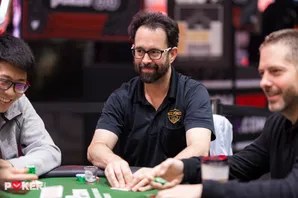
Brandon Wilson recently had a career-defining moment, securing his first PokerGO title and a $297,500 prize in the PokerGO Last Chance Event #3 $10K No-Limit Hold’em. His continued success in the tournament series solidified his rising star status in the High Roller circuit.
The PokerGO Tour, known for attracting top-tier high-stakes pros, is a competitive arena where even the most seasoned players face immense pressure. What makes Brandon Wilson, a newcomer to the high roller scene, so effective in these tough fields?
In this article, we’ll take a deep dive into a critical hand played during his heads-up match with Landon Tice. This hand is a perfect demonstration of Wilson’s key traits: theoretical mastery, aggressive play, and bold execution of big bluffs when the stakes are high.
You can find this hand, along with related preflop and postflop simulations, in the Octopi Vault (professional subscription required).
The Spot
The hand starts with blinds of 125K/250K and a 250K ante. Wilson has 25.9bbs on the button with 10♠ 8♠ offsuit, and Tice holds 31.1bbs in the big blind with Q♦ 7♦ offsuit, covering. The payouts are $297,500 for first place and $184,450 for second place.
For Wilson, a $113,050 pay jump and the coveted title are on the line, while Tice, with a slight chip lead, risks losing control of the match if he loses a major hand.
Preflop Action
Wilson begins by limping, and Tice checks. We can analyze their strategies using the custom sim from Octopi Vault to evaluate whether their plays were optimal and gain insights into their preflop ranges for postflop analysis.
Wilson’s Button Strategy
As the button, Wilson never folds. He leverages the pot odds offered by the big blind ante to play every hand, mixing up his play. The majority of his range is limped, allowing him to play cheaply while still protecting his stronger hands. He also raises about 25% of the time with strong hands and some weaker combos to balance his strategy.
Tice’s Big Blind Strategy
Tice checks most of the time (62%), but he has three raising options (3.5bb, 7bb, or an all-in for 26bb). His raises tend to be reserved for premium hands, with occasional bluffs sprinkled in. The larger raises target very good hands or hands with significant equity like suited connectors or high offsuit combinations.
Preflop Range Takeaways: Wilson’s limp range is wide, covering everything from premium hands to weaker ones. Tice’s checking range suggests he doesn’t have strong Broadway hands, pairs, or Ace-x hands, which would likely raise rather than check.
The Flop
The flop reveals three Broadway cards, which significantly favor Wilson’s range. Let’s examine the flop strategy in greater detail using Octopi’s range explorer.
Wilson is expected to bet frequently here, around 82% of the time, as his range (13% top pair+) is far stronger than Tice’s (2% top pair+). Wilson’s range includes sets, straights, and pairs, while Tice’s range is missing key Broadway cards and pairs.
Wilson opts for a 33% pot bet (1bb), which is standard for a hand like 10♠ 8♠. Tice, with his weak hand, defends 61% of the time due to the favorable pot odds.
The Turn
The turn brings the 4♠, completing a backdoor flush draw and giving Tice a pair. Tice checks again, and Wilson barrels with an overbet of 5.6bb (112% of the pot). Tice calls.
Overbets are typically used with strong hands or well-chosen bluffs to put maximum pressure on the opponent. Wilson’s overbet is designed to polarize his range, exploiting Tice’s weak holdings while extracting value from his strong hands. Tice’s call is reasonable, even with the marginal hand, as he’s still drawing to a possible flush or two-pair.
The River
The river brings the J♠, completing the backdoor flush. Tice checks, and Wilson, with no showdown value, shoves all-in for 116% of the pot.
This is a pure bluff, leveraging the spade blocker to prevent Tice from calling with flush hands. The logic behind the move is that Tice’s range is heavily weighted towards hands that could have made a flush, and Wilson’s bet is designed to force him to fold.
Tice folds, and Wilson claims the pot and the title.
Conclusion
Was Wilson’s play reckless or brilliant? The answer lies in the depth of his strategy. His well-timed bluffs, especially the river shove, were expertly executed with a deep understanding of the game’s mathematical and psychological elements.
For Tice, folding to the pressure was the correct decision from a Game Theory Optimal (GTO) perspective. His K♦ 4♠ lacked the necessary blockers to disrupt Wilson’s credible bluff range, and calling would have been a high-risk play with low expected value.
Brandon Wilson’s victory represents a masterclass in poker strategy, showcasing fearless aggression, flawless execution, and a keen understanding of the game’s nuances. When elite minds collide, every decision becomes a masterpiece.